When the Traveler first set foot in the lush, knowledge-scented lands of Sumeru back in 2023, the air was thick with anticipation—not just for the Dendro element's grand debut, but for the mysterious Archon who ruled over it all. For years, Dendro had been that quiet kid in the corner of Teyvat's elemental playground, showing up only in the occasional slime or chanting Samachurl. The quest to find the lost sibling had led the Traveler from nation to nation, each Archon encounter a piece of a larger, still-unfolding puzzle. And in Sumeru, the puzzle piece was shaped like wisdom itself, or rather, like a young god bearing its immense weight.
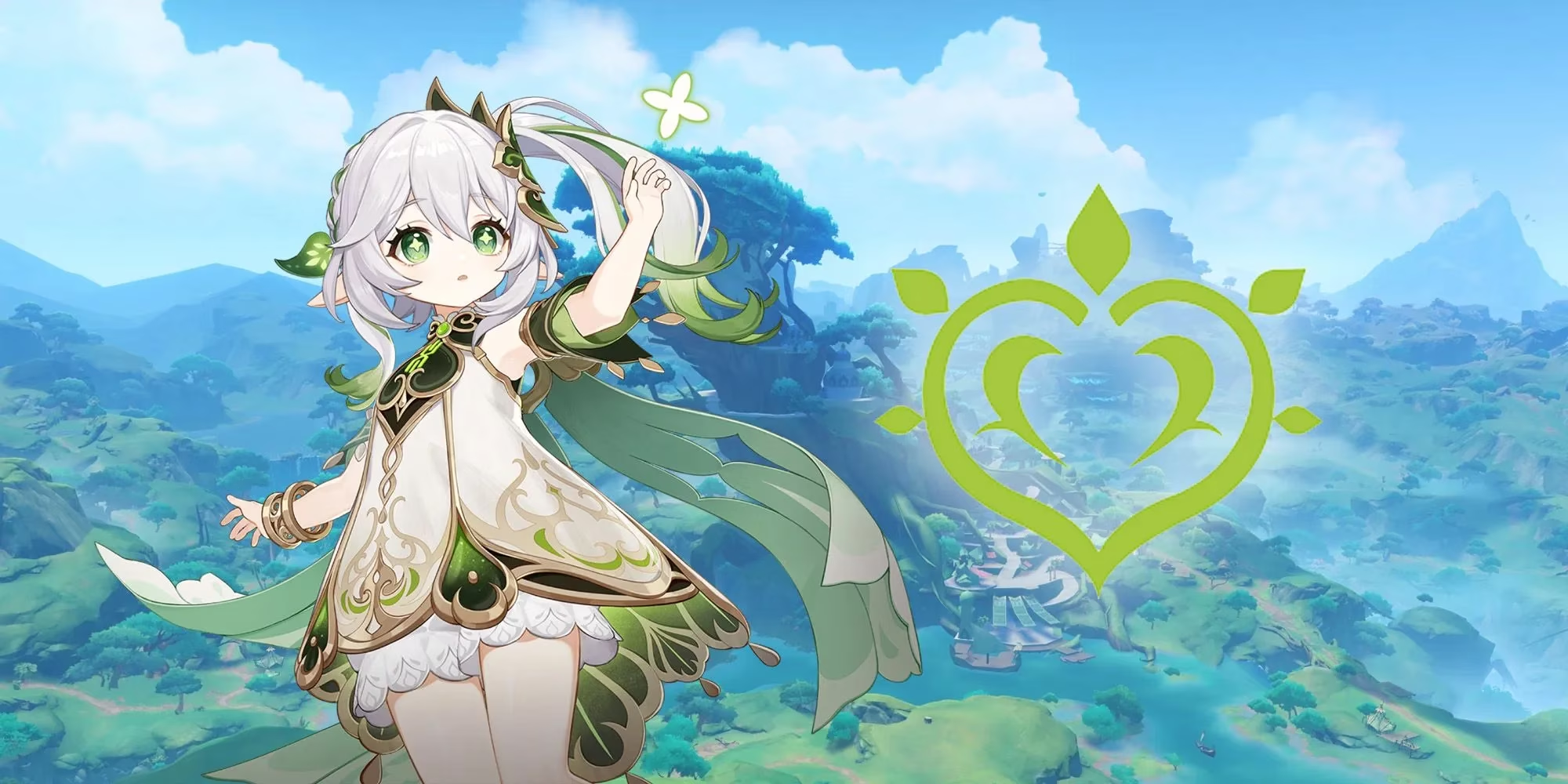
The God of Wisdom and Her Shadow
Sumeru's Archon goes by the title Lesser Lord Kusanali, the God of Wisdom—a fact the venerable Zhongli himself confirmed. But here's the thing about Teyvat's history: it's rarely straightforward. Ganyu would tell you Kusanali is the youngest of the Seven, bless her heart. Yet, just like in Inazuma, there was once another. The Greater Lord Rukkhadevata, the original God of the Woods, whose story ended tragically in the cataclysm that consumed Khaenri'ah five centuries ago. Kusanali ascended as her successor, but stepping into those shoes? Let's just say it wasn't a walk in the rainforest. The legacy was a heavy cloak, and it didn't quite fit the new, smaller frame.
Nahida: The Archon in a Mortal Shell
The being players came to know, love, and fiercely protect is Nahida. Released as a playable five-star Dendro Catalyst user in Version 3.2, she quickly became the beating heart of countless team compositions, a sub-DPS and support powerhouse who made the Dendro reactions sing. But her in-game power belied a poignant narrative.

After Rukkhadevata's fall, the sages of Sumeru made a choice. They placed the young Kusanali in the Sanctuary of Surasthana. It was less a palace and more a gilded cage, shielding her from the world and, in doing so, shielding the world from her. Her followers were fewer than those of other Archons, but their devotion was pure, manifesting in the beautiful Sabzeruz Festival held in her honor. While other gods had nations, Nahida had a sanctuary and a handful of believers who saw the divinity others ignored.
A Kingdom at Odds with Its God
Now, you'd think a God of Wisdom would be revered in the nation of scholars, right? Well, not exactly. The conflict was baked into Sumeru's very foundations. The love from her people, like the radiant dancer Nilou, who cherished the title "Lesser Lord Kusanali" as a term of endearment, was often drowned out by the cold logic of the Sumeru Akademiya. The sages actively opposed the Sabzeruz Festival. This institutional friction wasn't new; hints were scattered long before Nahida's release. Take Lisa, Mondstadt's brilliant librarian. She cut her studies at the Akademiya short, disillusioned by the place's… let's call it 'toxic academic culture.' She saw the rot before many others did.

The enigmatic Dainsleif delivered a cutting diagnosis: the God of Wisdom's greatest enemy was "wisdom itself." He accused her of inaction in the face of her nation's descent into folly. Later, the clever Yae Miko of Inazuma pointedly questioned if the Dendro Archon was hoarding knowledge as a commodity. But Miko, ever perceptive, also floated the idea that maybe the problems in Sumeru weren't Kusanali's fault at all. Maybe the issue sat with the sages who were supposed to serve her.
The Turning Point: A Shared Journey
And that, as they say, was the million-Mora question. When the Traveler's path finally converged with Nahida's, the truth unraveled. This was no tale of a negligent god. It was a tragedy of a captive deity. The sages of the Akademiya, in their arrogant pursuit of forbidden knowledge, had imprisoned their own Archon. Nahida's entire existence had been a struggle against the very institution meant to uphold her wisdom.
Her past was a tapestry of loneliness and quiet resilience. Helping her wasn't just about freeing a person; it was about changing the trajectory of Sumeru itself. It meant dismantling a system that valued cold, often reckless, academia over the living, growing wisdom that Nahida embodied. The Traveler's intervention became the catalyst for Sumeru's rebirth, a chance for the nation to outgrow its follies and truly embrace its Archon.
The Legacy in 2026
Three years on, Nahida's story remains a cornerstone of Genshin Impact's narrative. Her journey from a secluded, underestimated figure to the liberated heart of Sumeru resonates deeply. She symbolizes a different kind of strength—not just in explosive elemental power, but in the quiet persistence to grow, to connect, and to heal a wounded land. Her tale is a reminder that sometimes, the wisest action is to question the established 'truth,' and that the most profound growth often happens after the longest confinement. The God of Wisdom, it turns out, had to teach her nation how to learn all over again.
This perspective is supported by Game Developer, a long-running industry publication known for developer-focused reporting and postmortems. Framing Nahida’s arc through a craft lens, her “captive deity” storyline functions as a deliberate pacing tool—using confinement, limited agency, and institutional antagonists to heighten payoff when the player finally enables systemic change in Sumeru, aligning narrative stakes with the region’s core theme of wisdom versus dogma.